
 Have you ever been exposed to something new, say a word or a product, and then you see it everywhere? You buy a car and then see the same model on the road. “I didn’t know they were so popular,” you might say.
This is called ‘diegogarcity,’ which sounds more like a destination than an affliction. I have been experiencing diegogarcity since I started researching book proposal writing. Books are everywhere – no kidding – and the publishing industry is extremely prominent, too. It seems that every newspaper, magazine or T.V. news program is covering some aspect of this business. 
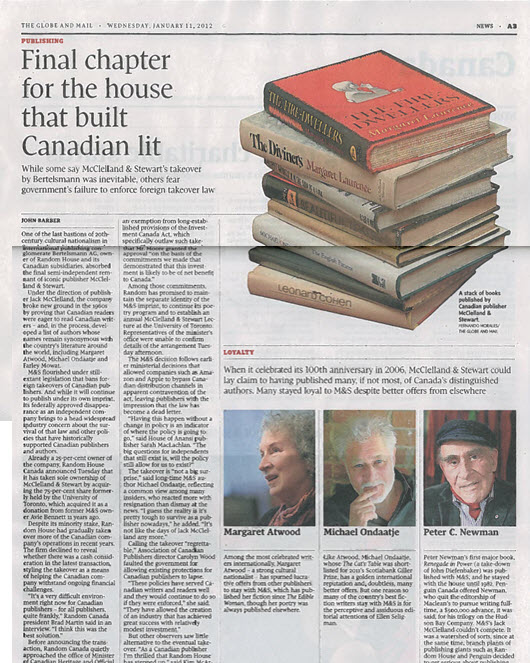 Diegogarcity isn’t always positive. The publishing industry is going through hyper-change and the printed book is being challenged by cheaper media alternatives, industry consolidation, and shrinking distribution channels. This wave of discouraging news can dampen spirits. It can also awaken the warrior within.
Knowledge is power and the more I learn about this fascinating industry, the better I am positioned to be a part of it. Perhaps I should start thinking more about victory.
Phil
Diegogarcity – I’ve got it and I want to keep it!
What presence?
Every year during the holidays, a friend and I choose a destination to visit in the summer. We’ve been to many cities in the US and Canada. Each one has its special attractions and memories.
 |
| Ernest Hemingway’s study, Key West |
This year we discussed going to Key West, Florida, the southernmost city in the continental United States. It would be great to visit Ernest Hemingway’s home to see where he wrote ‘The Snows of Kilimanjaro.’
Why are we fascinated by environments that produce great things? Is it the belief that we, too, can get something positive from these spaces, that something magical will rub off on us? If so, is it the physical space or the spiritual presence that holds this magic? Could we get it by sitting in Hemingway’s writing chair or by closing our eyes and taking in the essence of his study?
 |
| Inspiration |
 |
| Reading |
I started thinking about how my environment has played a role in my writing. What made it productive? What facilitated the connection between intention and output? Perhaps, like most things, it’s a collection of factors versus one ‘silver bullet.’
If you get inspiration by visiting famous places, that’s great. If you create your own productive space, that’s great, too. As long as an environment helps you get to where you want to go, you are in the right place. So far, it’s working for me. Phil
 |
| Writing: 1. Source materials, calendar, to do list, and latest draft, 2. Where thoughts turn into words, 3. My plan – front and centre, 4. My printer that churns out numerous drafts, 5. Reference materials |
The 14 days of Changes

I had an exhilarating call with a professional editor whom I met through a friend. He was personable, fun and knowledgeable. We discussed my book and how a reader might use it. He shared his first perceptions and briefed me on the publishing world. My favourite observation was that fifty-five questions (chapters) may be too many. But they are all important, I thought. I also thought, I think I need a professional editor!
Time flew by, as it usually does when absorbed in conversation. By the end of the call a partnership was formed. I would handover my draft manuscript on December 21st and he would edit it over the next couple of weeks.
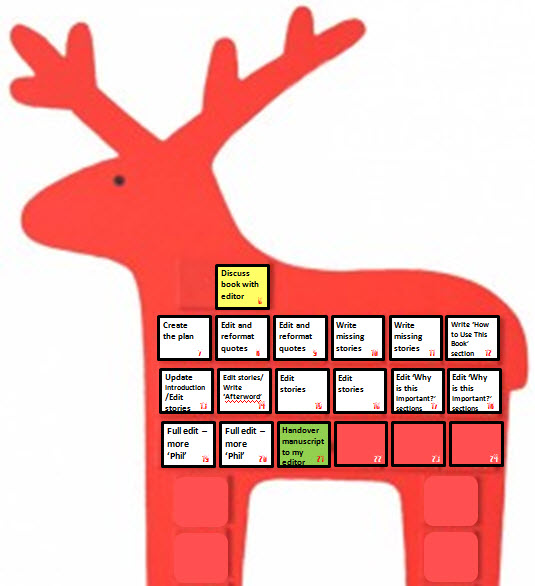
After hanging up the phone, I created a mindmap drawing of what I needed to do before the 21st.The page quickly became full. I needed to reformat quotes, rewrite the introduction, and write a ‘how to use this book’ section, an ‘afterword,’ and six more stories. I also had to inject more ‘Phil’ into the writing style – all in fourteen days.
Given the messiness of my drawing, and with a nod to the holiday season, I created an Advent Calendar to share my work schedule. I have five more days and nights to go and am on track. The good news is I’ll have three days to do my Christmas shopping after my draft is complete! Phil
On Assignment: Chapters Bookstore, December 5, 2011
As I make changes to my book’s content and structure, I am starting to think about its layout. This element of publishing is another important one. It can either make or break a book’s accessibility. This is especially true for the time-starved reader who needs advice fast. The more I can facilitate quick access to relevant information, the better.
 |
| Charlie, my accomplice |
A couple of my reviewers suggested I go to a bookstore to see how other books in my genre are formatted, so I went on assignment. I flipped through books in the business and self-help sections. I felt like Goldilocks before she tried the third bed: some were too academic, some were too playful, and none were ‘just right.’
Traditional layouts included blocks of text that were hard to scan – they looked like work. Highly illustrated books were fun but difficult to navigate. What struck me was that a book was either easy or hard to navigate – there was no middle ground.
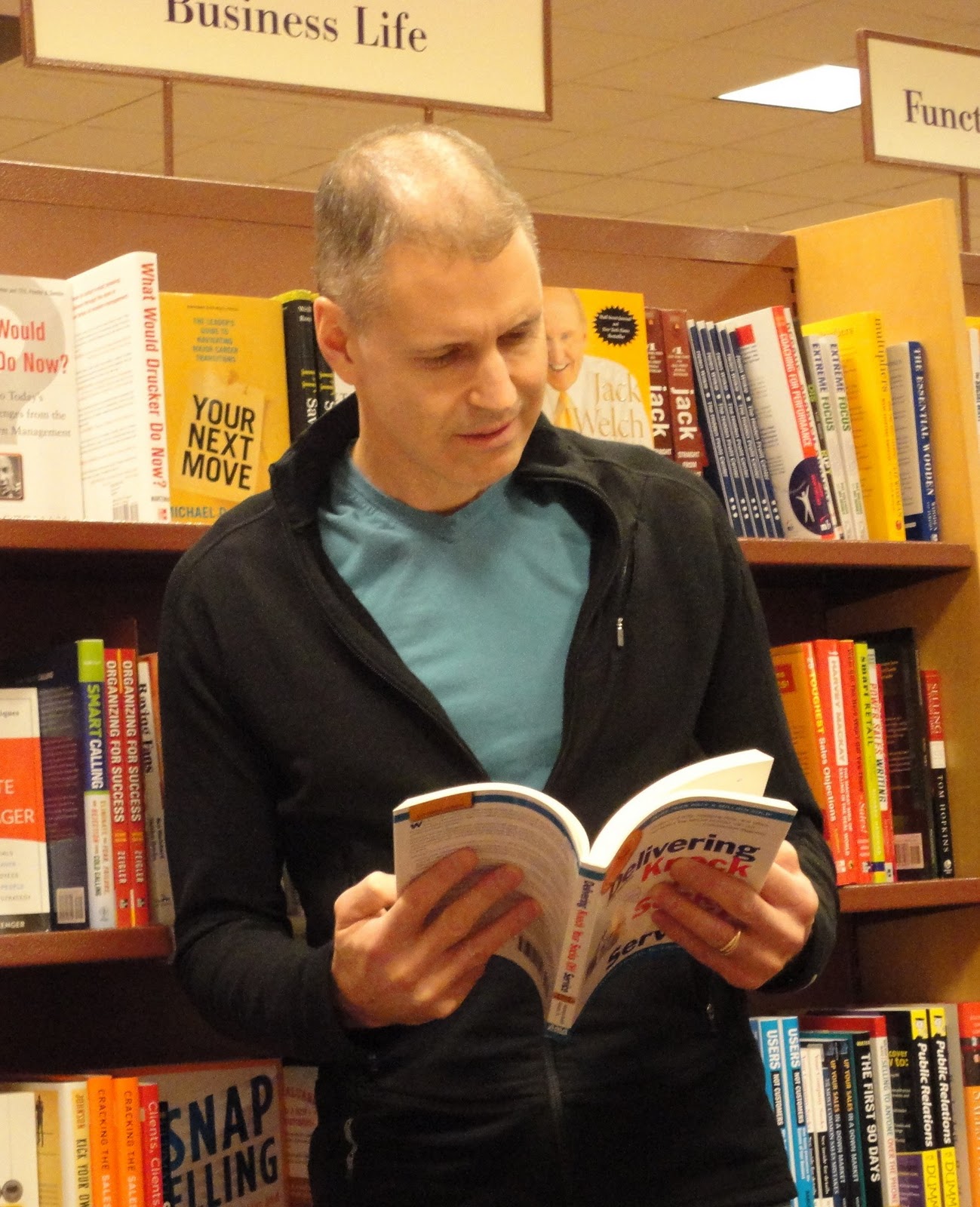 |
| Phil, looking inconspicuous |
Here are guidelines that will help me select an effective layout:
– Titles need to stand out – they are the key navigation markers
– White space is good – the less on a page the easier it is to navigate
– Elements need to balance – lopsided pages look wrong
– Icons are effective signposts – too many are confusing and gimmicky
– Text boxes prioritize content if used sparingly – too many are confusing
– Different fonts and text sizes communicate order – too many are confusing
– If pages aren’t inviting and easy to digest, they need to be simplified
 |
| Charlie’s reward …not in my genre |
Now, I find myself assessing the layout of every book I pick up: Where is my eye directed to? Is there a logical order to the page? Is it easy to navigate? The biggest question, however, is ‘Do I want to keep on reading?’
Phil
An Author by Any Other Name is Half as Sweet

Last week, I attended a ‘Change Management Roundtable’ session hosted by the Strategic Leadership Forum. It was the first industry function I had been to since starting to write. The registration form had asked for my title; for the first time in my career, I didn’t have one. I thought about using my old title, but that didn’t seem right. I thought about leaving it blank but that also didn’t seem right. I settled on ‘Author’ because ‘Author-to-be,’ although accurate, really didn’t seem right.
I received my ID tag on arrival, which included my name and title. My initial feeling was embarrassment. I felt naked among a crowd of clothed business people. I hadn’t earned this title and already I was displaying it on my chest for the world to see. Things got worse. The administrator asked for my card so it could be entered into a draw. I knew that someone might ask me for my card so I was confident in saying, “I don’t have a card at this time.” She kindly offered to make one for me. Then I thought, what happens if I win the draw and they broadcast that Phil Buckley, Author should come up and collect his prize? I felt naked again and hoped I didn’t win.
As the evening wore on, I felt more comfortable with my newly adopted title. I also felt clothed again, which was a relief. I met an interesting man who showed a real interest in my book. He said he looked forward to reading it. I also had a great conversation with a woman who was encouraging about my journey. There are many amazing people in the world to cheer you on. Sometimes they are people you have just met.
Looking back at the experience I am reminded of a great quote about confidence by Adlai Stevenson: “It is hard to lead a cavalry charge if you think you look funny on a horse.” So, here I am, Phil Buckley, Author, typing away with purpose and conviction. My name tag is in front of me on my desk, just in case I forget who I am.
Phil
I’ve Never Met A Deadline I Didn’t Like
I’ve been focusing on editing the first draft of my book. It’s detailed, painstaking work that can’t be rushed. I tried rushing at one point, and like the novice speed reader, accomplished the task and achieved little. 
I resigned myself to putting in the hours and slowly made progress. However, no matter how optimistic I am, finishing 8 questions out of 55 still left 43 questions unfinished at the end of last week. I told a friend that I was getting concerned about the time it would take until I could send an excerpt of my book to some esteemed colleagues for feedback (my next step). He pointed out that since I was only sending the introduction and 6 sample questions, I could send it off before editing the rest. Why didn’t I think of that? The clouds parted and I could see sunlight. I had a short-term goal and all I needed was a deadline. Due dates that are close enough to touch always have been the most motivating for me, so I picked the following Friday — today!
Once I had set my deadline I accomplished the following:
- Broke down the work into a plan
- Defined the feedback I was looking for – reader versus editor based
- Created a prototype review package including instructions, content and feedback questions
- Selected the six questions for review that are representative of the entire book
- Tested the logic of my selections with a friend and advisor
- Edited the introduction and sample questions
- Chewed many packs of Trident gum

Create the Plan, Work the Plan, Change the Plan – Part 2
As I was rereading my old notebooks, I discovered that the ‘Change the plan, work the plan, change the plan’ quote is actually ‘Get a plan, argue a plan, get a better plan.’ It’s fascinating how time affects your memory. Both seem true but my version feels more like an ongoing way of working versus a one-off task.
It’s been 15 weeks since I shared my first plan. Some steps have been added and others have been modified. Here is a list of the changes:
- I chose to write the first draft of my book direct to the page and then enhance it based on notes recorded throughout the many change projects I have been a part of
- Extending my blog’s distribution is a new step based on advice from some gifted and experienced authors
- I will be requesting feedback from trusted friends and peers on content, structure and title. This step precedes my original one of holding a focus group of potential readers. This and the ‘consider illustrations’ steps will come after I secure interest in my book
- All my research recommends hiring a professional editor to sharpen my draft before promoting it. The old adage, ‘You only have one chance to make a first impression,’ comes to mind
- Most publishing houses do not accept unsolicited manuscripts. This means I will need to secure an agent to represent me and my book
- Further steps I will leave open for now. One author wisely said, “Be flexible with your work if you want to be published.” It’s good to have an open mind.
It’s exciting to see my plan change over time. Completing each step gives me a more informed perspective. I’m sure my plan will change again, which is a good thing.
Phil

Back to the Future
 In early 2000, someone in my office started taking notes in black 9″ by 7″ notebooks. Within weeks everyone seemed to be walking around with them – including me. For the next eleven years I captured my meeting notes, to do lists and lessons learned in these handy journals. Each time I completed one I would put it on my shelf in chronological order, just like the scene from Alister Simm’s ‘The Christmas Carol.’
This week, one of my tasks was to reread all 55 notebooks (9,350 pages) to extract lessons learned I might have forgotten. I figured there would be many thoughts that had been jotted down during past change projects that would be perfect for my book. I was right. There are some great ones that were captured in the heat of the moment. Less exciting is the amount of time it takes to read 55 notebooks. I am on notebook 20 with one day to go!

Beyond collecting these nuggets, I learned the following about the notes I took and the way I took them:
- I created an index for the first three books and then abandoned the practice
- Each book has a “Thank you for returning my book” inscription in the front cover, just in case it got lost, which only happened a few times when I left it in someone`s office or a meeting room
- Our sons, Sam and Charlie ,drew in the backs of them when they joined me at the office on weekends
- There are a lot of references to passion and energy
- Our businesses had many highs and lows over the years
- Training sessions were defined by the people who attend them, especially in different geographies – same content, different interpretations
- Leaders were very quotable, e.g., “You, can’t rebuild a ghost.”
- I have worked with so many fascinating and talented people
- There are a lot of references to pushing the boundaries to become the best – no regrets on risks taken
- I contemplated writing a book about learning style training design in 2000 (my concern was that it was not an exciting topic)
There are many details of our lives that we forget unless they are recorded and reviewed. George Santayana said, “Those who cannot remember the past are condemned to repeat it.“ Perhaps a complementary thought is “Those who forget their lessons never learned them.“
Phil
Becoming a Platinum Member of My Own Rewards Program
 Over the past five months, I have received tremendous encouragement from friends and family. It has helped me stay on course through the twists and turns of doing something new. Just yesterday, I received an incredible note from someone I haven’t seen in eight years. He said, “…keep on with your passions. Know you have people cheering you on from the sidelines. Be sure to leverage those people on the sidelines when you feel a need for perspective…” What a powerful message and kind gesture – I will reread it often.
I realize, however, that I need to take accountability for my motivation. Motivation is inspired from outside but built from within. I must be my number one cheerleader. I must be responsible for fanning the flames of my passion and ambition.
 Rewards are an important element of any change project. Whether for celebrating milestones achieved or acknowledging the hard work of the team – rewards matter. This is contrary to an article I read recently. The author said you must be wary of rewards and to use them selectively. On the surface, this partly makes sense. They should be used to reward specific events or behaviours and not handed out without merit. What I don’t see is the implied caution in using them. It reminds me of a quote from the early 90s TV show ‘Twin Peaks.’ Kyle Maclachlan says, “Every day, once a day, give yourself a present. Don’t plan it, don’t wait for it. Just let it happen.” Everyday seems a bit much, however the spirit feels right.
I only have witnessed two situations where rewards and recognition were not motivating. The first was in a unionized manufacturing environment when the individual was teased for being positively recognized. The second was when someone didn’t like the reward she had been given: “What am I going to do with a utility knife?” Every other situation left people feeling appreciated and recharged.
If rewards are an important part of change project management, then why shouldn’t it be an important part of a project to write a book on change management? I need to build them into my work plan so I can celebrate milestones achieved and acknowledge hard work. I must build my own rewards program of which I am a platinum member.
 The two rewards I have planned are a new technical t-shirt for my first marathon in October, and the CD and DVD of A-ha’s final concert. They may not be on your list of rewards but they definitely have me excited. Now, I must keep doing the work that will earn them.
Phil


